 Norsk språk
 English
 Pусский
 Français
 Español
 Portugues
 Deutsch
 lingua italiana
 العربية
 Melayu
 Filipino
 Монгол хэл
 dansk
dansk Bahasa indonesia
 日本語
日本語 한국어
한국어 Türk dili
 Tiếng Việt
 svenska
 Nederlands
What is an objective? |
|
The objective is the most important part of the microscope optical system. As part of the microscope optical system, the objective lens is mainly responsible for collecting the light emitted or reflected by the sample and focusing it to form a microscopic magnification image. The imaging quality of a microscope mainly depends on the quality of its objective lens. The design of the objective lens directly determines the key parameters such as magnification and resolution that the microscope can achieve, and is the primary standard for measuring the quality of a microscope.
|
|
The objective lens is usually installed on the converter between the head of the microscope and the workbench, which facilitates fast and accurate movement into/out of the optical path. As shown in the figure below, The lift figure is the converter of a upright microscope, with the objective lens and workbench facing downwards to treat the observed object.
|
|
|
|
|
In another type of inverted microscope, the workbench and transducer positions are exchanged to form an inverted structure, and the objective lens is mounted on the transducer, facing upward, still facing the observed object.
|
|
|
|
|
The structure of the objective lens is complex and the production is precise. It is composed of lens groups fixed at a certain distance inside the metal tube of the objective lens to eliminate aberrations. Each group of lenses is made up of one to several lenses with different materials and parameters glued together to eliminate chromatic aberrations. The front lens of the objective lens is called the "front lens", and the back lens is called the "rear lens".
|
|
|
|
The shell of the objective lens is usually marked with some main parameters and features. The most important magnification factors, such as 10x, 40x, 100x, etc., indicate how much the objective lens can magnify the image. The numerical aperture (NA) of the objective lens is also very important because it determines the minimum resolution that the objective lens can resolve and the amount of light entering the lens. The higher the numerical aperture, the stronger the ability of the objective lens to collect light, thus providing higher resolution.
On the shell of the objective lens in the figure below, "Plan" indicates that the objective lens is a flat field objective, "APO" indicates that the objective lens is an apochromatic objective, "60x" indicates a magnification of 100x, "1.40" indicates a numerical aperture of 1.40, "Oil" indicates that the objective lens is an oil immersion objective, "∞" indicates that the objective lens is designed for infinity optics, "0.17" indicates that the coverslip thickness applicable to this objective lens is 0.17mm, "WD 0.21" indicates a working distance of 0.21mm, and "DIC H" indicates that the special optical function of this objective lens is designed for differential interference phase contrast.
|
|
|
What are the main parameters of the objective lens? |
Magnification |
|
Refers to the magnification of objects observed by the objective lens, generally including 2x, 4x, 5x, 10x, 20x, 40x, 50x, 60x, 80x, 100x, etc. The following picture shows a set of infinite-distance flat-field achromatic objectives with magnifications of 4x, 10x, 20x, 40x, 100x.
|
|
|
Numerical aperture: |
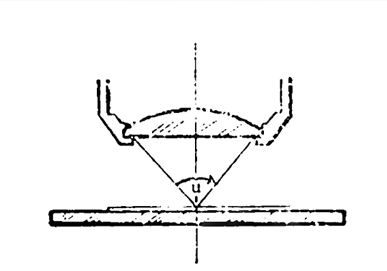 |
Numerical aperture refers to the product of the sine of the acceptance angle of the objective lens and the refractive index of the medium. It is an important parameter describing the ability of a microscope objective lens to collect light, usually marked as NA on the objective lens.
A larger acceptance angle and high refractive index medium can increase the numerical aperture, allowing the objective lens to collect more light. The larger the numerical aperture, the higher the theoretical resolution of the objective lens. When choosing an objective lens, numerical aperture is an important consideration. High-resolution applications, such as detailed imaging of cell structures or microorganisms, require objectives with high numerical apertures. For low magnification observations or when a larger depth of field is required, a lower numerical aperture is more appropriate.
|
Conjugate: |
|
Conjugate distance refers to the distance from the object point to the image point in the microscope optical system, which is generally common 185mm, 195mm, and infinity There are three types. The 185mm conjugate distance is a common standard in early microscope designs. Microscopes of this design are usually used for standard optical observation and are suitable for education, laboratory research, and some basic industrial applications. The 195mm conjugate distance provides a slightly longer optical path for the microscope, which may allow for the insertion of more optical components and more imaging flexibility. The infinity conjugate distance objective lens refers to the objective lens not directly focusing the image at a fixed distance, but producing parallel beams of light. These beams of light are then focused by other optical components within the microscope (such as tube lenses) to form clear images. This design allows various optical components to be added between the objective lens and the eyepiece, such as reflected light sources, overview devices, filters, polarizers, etc., without affecting the focus and clarity of the image. It is very suitable for microscopes that require versatility and high flexibility,
|
|
|
Parfocal and Coaxial : |
|
Zoom refers to the fact that when the objective lens of a certain magnification is used to observe the image clearly during microscopy, the imaging should also be basically clear when switching to the objective lens of other magnification, that is, the clear imaging focus of each objective lens should remain consistent. Axis This ensures that the center point of the sample deviates from the center of the field of view within a certain allowable range when the objective lens is switched. Zoom and axis usually appear together in the design of microscopes, and high-quality microscopes are all axis and focus. The combination of these two characteristics allows users to quickly switch between objectives with different magnifications without repeatedly repositioning the sample or adjusting the focus, greatly improving work efficiency and convenience of observation.
|
|
Parfocal distance is usually 35mm, 45mm and 60mm, as shown in the two examples on the right side of the figure below, which are 45mm and 60mm. Teaching microscopes have lower prices and smaller machine sizes, generally using 35mm parfocal distance objective lenses. Mid-range microscopes have larger sizes and often use 45mm parfocal distance objective lenses, while high-end microscopes have larger machine sizes and mostly use 60mm parfocal distance objective lenses. The internal space of the objective lens is larger to facilitate the design and use of more complex optical systems.
|


 Huang Xin